
Chinese Tourists Become Singapore’s Top Source of Inbound Visitors; Chinese Enterprises Going Global Are Fueling an Innovative New Business Model
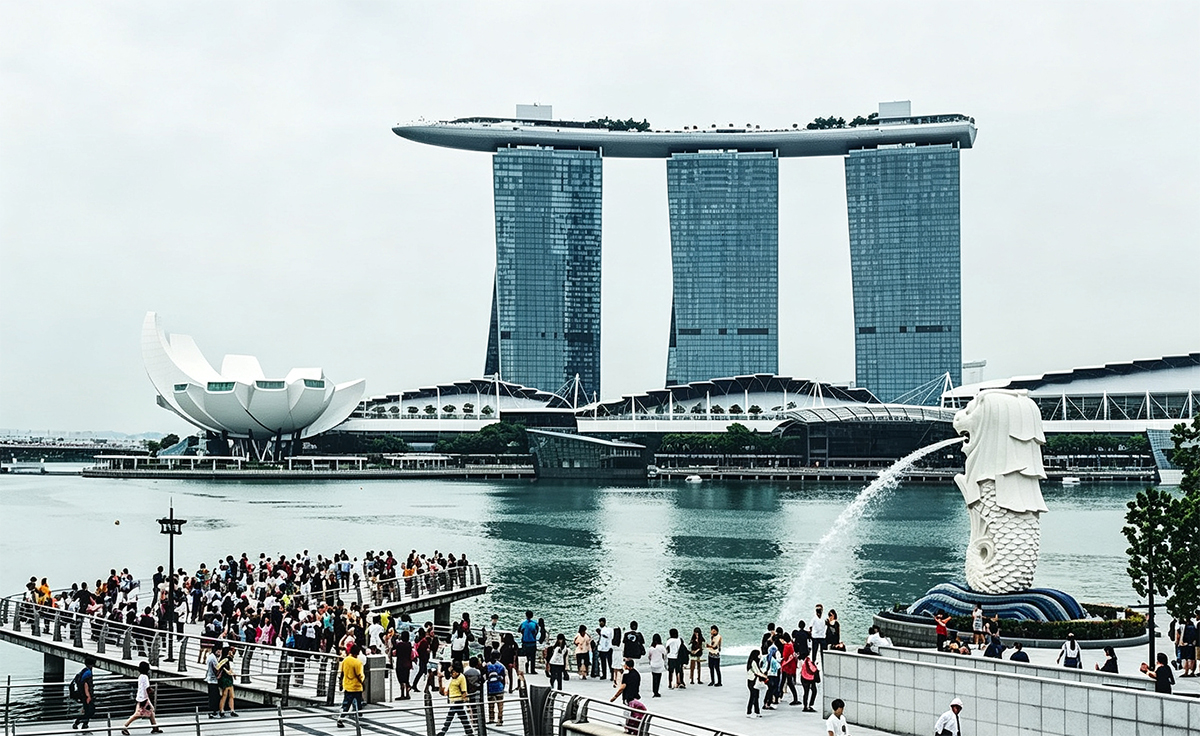
According to data released by the Singapore Tourism Board on August 17, the country received 1.6 million international inbound visitors for the month, a slight 3% drop year‑on‑year. Nevertheless, arrivals from Chinese mainland bucked the trend with a 4% year‑on‑year increase. With a cumulative total of 1.9 million visitors, Chinese mainland secured its position as Singapore’s largest source market.
For the full‑year 2025, Chinese tourists hit 3.1 million, making China Singapore’s top source of inbound visitors as well as its highest‑revenue tourism market.
Where does this 4% growth come from?
Beyond the boost from summer‑vacation family travel, one fast‑growing group cannot be overlooked: Chinese business professionals travelling to Singapore for trade shows, conferences and market research.
The wave of Chinese enterprises going global has emerged as a new driver for Singapore’s inbound tourism. Today, many Chinese travellers visit Singapore not merely to see the Merlion or Universal Studios.
They come with demands for school assessments, alongside tasks such as exhibition attendance, conference participation and building business presence across Southeast Asia. Chinese companies’ overseas expansion is reshaping how Chinese visitors engage with Singapore.
Singapore: The First Stop for Chinese Enterprises Expanding Overseas
Singapore has become the preferred foothold for Chinese firms venturing into Southeast Asia and the broader Asia‑Pacific market. Industries represented by Chinese companies scaling up in Singapore span diverse sectors: feed manufacturer Haid Group, furniture maker KUKA Home, internet giants ByteDance and miHoYo in e‑commerce and gaming, clean‑energy player Envision Group, and biopharma firm WuXi AppTec, among others.
Chinese investment is shifting from light‑asset operations toward deep‑rooted heavy‑asset deployment. Last year, China’s fixed‑asset investment in Singapore surged eight‑fold, accounting for one‑fifth of total foreign investment and surpassing that from the United States.
Rather than chasing short‑term gains, Chinese‑funded enterprises are pursuing long‑term regional capacity building. As a regional data‑hub node with abundant submarine‑cable infrastructure connecting Europe‑Asia, America‑Asia and Southeast Asia, Singapore serves as an ideal location for Chinese corporations to build global coordination platforms.
Fang Zhangwen, Chairman of the Singapore Economic Development Board, noted that Chinese enterprises expanding their footprint in Singapore cover a wide range of industries. This is accompanied by frequent travel by corporate executives, business delegations and exhibition teams — the core driver behind Singapore’s booming business‑travel segment.
Chinese Overseas Expansion Boosts Singapore’s MICE Industry
Chinese‑company globalization brings not only investment but also tangible growth for Singapore’s MICE (Meetings, Incentives, Conferences and Exhibitions) tourism.
In 2025, Singapore’s MICE revenue reached SGD 2.3 billion, marking a 35% year‑on‑year rise. Pan Zhengzhi, Chief Representative for Greater China at the Singapore Tourism Board, commented: “Previously, when sourcing MICE events, we looked for intellectual property from Western markets. Now the tide has turned. China boasts many high‑quality IPs favoured by global audiences, and we can bring Chinese IPs overseas.”
Pop Mart offers a typical example. In August 2025, a drone‑light show lit up Marina Bay and went viral across Chinese social‑media platforms. Popular Chinese‑origin toy characters including Labubu and Dimoo illuminated the Marina Bay skyline as part of Pop Mart’s 2025 International Toy Fair — the first high‑profile showcase of a Chinese IP in Singapore of such scale.
Chan Chun Wai, Assistant Vice‑President of Regional Marketing at Resorts World Sentosa, commented: “Despite tourism headwinds stemming from developments in the Middle East, Chinese visitor arrivals at Sentosa have maintained steady growth, especially business travellers. Numerous Chinese conference groups visited Sentosa between April and June.”
Singapore has designated MICE as a core growth engine under its Tourism 2040 Vision, allocating SGD 740 million from its tourism‑development fund over the next five years. Foo Kee Chuan, Executive Director of Exhibitions & Conferences at the Singapore Tourism Board, pointed out: “Convenient air links together with mutual visa‑free travel between Singapore and China greatly facilitate personnel exchanges and commercial cooperation.”
Three‑stage Progression: From Exhibition Attendance to Local Establishment
Business‑related travel by Chinese enterprises in Singapore has evolved far beyond simple conference‑going and exhibition visits, maturing into a complete overseas‑expansion pathway.
Stage 1: Exhibition Participation & Market ExplorationOn 26‑27 August this year, The Business Show Asia will be held at Marina Bay Sands Expo and Convention Centre. It is expected to draw over 8,000 attendees, 250 exhibitors and 150 speakers, with 95 % of participants holding procurement‑decision‑making authority.
ITB Asia 2026 will run from 21‑23 October, projected to attract more than 18,000 participants and over 1,000 exhibitors. Such events act as key channels for Chinese firms to understand Singapore’s market landscape and identify local partners.
Stage 2: Practical Training & Business AlignmentAn increasing number of Chinese local‑government bodies and corporate organisations are launching “overseas training camps”. In 2025, Zhongguancun Fengtai Park organised enterprise delegations for Singapore‑based training programmes, arranging intensive visits to key institutions including the Singapore Economic Development Board and Singapore Exchange.
Cixi Branch of Bank of Ningbo also led more than 20 well‑known enterprises such as Bull Group on study tours to Singapore, facilitating in‑depth exchanges with local law firms, accounting practices and financial institutions.
Stage 3: Physical Local‑market Establishment
Following market research and exhibition‑based outreach, growing numbers of enterprises choose to set‑up physical presences in Singapore.
Demand for services covering company incorporation, corporate‑secretarial work, accounting, tax planning and legal compliance is rising rapidly. Singapore features low barriers to company registration for intending investors: the minimum registered capital stands at merely SGD 1, and approval can be completed within a single working day in optimal cases.
From exhibition‑site discovery and practical‑training programmes all the way to physical on‑the‑ground establishment, Singapore is evolving from …
This is ready‑to‑use translation material for cross‑border‑news release. The work‑task mode can help polish headline alternatives, social‑media snippets and supporting graphic ideas, would you like to proceed with it?